
TIM SCHROEDER
Work / Thumbnail Bench
Creator AI Tool

ThumbnailBench

An AI workbench that helps YouTube creators pick a thumbnail idea, render it with their own face, get honest notes, and see if it worked.

Live · new signups closedSep 2026
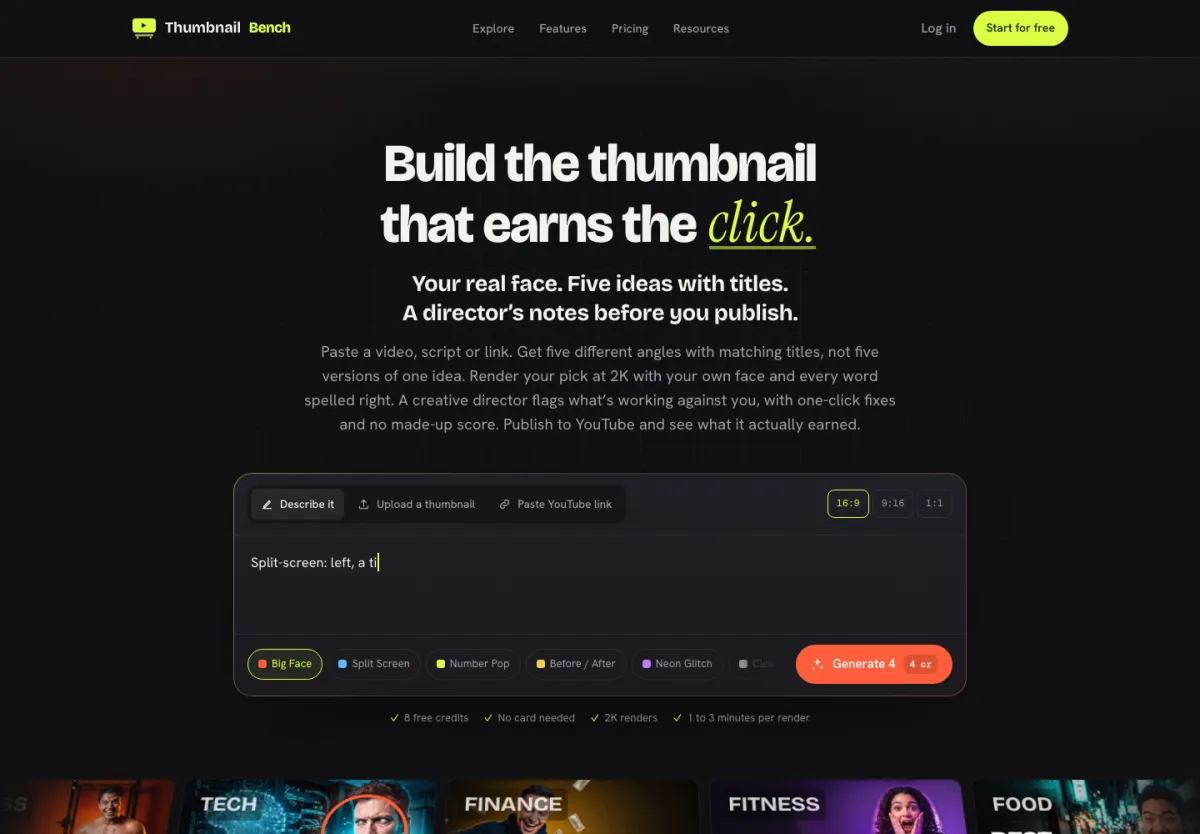
Thumbnail Bench homepage with the headline 'Build the thumbnail that earns the click', a prompt box with style chips and a Generate button, and a row of example thumbnailsReal screenshot · public homepage

The problem

A thumbnail decides whether a video gets clicked. Creators struggle to pick the right idea, keep their own face, get the words spelled right, and learn whether the new thumbnail helped.

Who it's for

YouTube creators who make their own thumbnails.

Where AI is used

Claude Opus 5 writes thumbnail ideas with titles and reviews finished renders. Image models on Kie and fal.ai render the picture, cut out faces and make edits.

Built with

  • Next.js 16
  • Postgres + Drizzle
  • Claude Opus 5
  • Nano Banana 2 (Kie)
  • fal.ai
  • Stripe
  • Railway
  • Cloudflare
01 · The problem

Drawing the picture is the easy part

Most AI thumbnail tools turn a prompt into a picture. The hard part for a creator comes before and after that: which idea to try, whether the face still looks like them, whether the words are spelled right, and whether the new thumbnail changed anything.

Midway through the build, YouTube Studio started generating thumbnails for free. That made the plain render step a commodity, so the product moved toward the steps around it.

  • Tools give five versions of one idea, not five different ideas.
  • Image models garble words and drift away from the creator's real face.
  • Feedback before publishing is either missing or a made-up score.
  • After publishing, creators rarely see whether the thumbnail moved click-through.

Why custom software

The competitor research found no tool that joined ideas with paired titles, a real face, a structured critique, and a per-video click-through reading. YouTube's own free generator covers only the render.

02 · The solution

A workbench for the whole thumbnail decision

Thumbnail Bench walks a creator from idea to published thumbnail. AI drafts and reviews. The creator decides.

AI

Plan: five ideas with titles

Paste an idea, a YouTube link, a script or upload the video. Claude Opus 5 returns five different angles, each with a matching title, and sends the chosen one to Create.

AI

Renders with your real face

Nano Banana 2 renders at 2K, with GPT Image 2 as an opt-in second model. Face Lab cuts out a selfie and builds an expression set to reuse.

AI

Review: a creative director's notes

Claude reads the render against a rubric. It names what to keep and up to four faults, each with a Fix it button. It also checks likeness against the creator's photo.

AI

Editor with real text layers

Headlines can be drawn by code, not painted by the model, so every word is spelled right. AI edits can be locked to one region of the image.

Publish and measure

Connect YouTube, replace a thumbnail with a two-step confirm, then see that video's click-through against the channel's own baseline.

Credits, billing and spend controls

A credit ledger, live Stripe plans and top-ups, automatic refunds when a render fails, and an admin kill switch that stops every paid AI call within 30 seconds.

03 · My role

What I did. What the AI did.

I owned the product: what it should do, which models to use, what to test, and when to ship. Claude Code wrote the code.

Tim · human judgement

I owned

  • Set the concept and, after a competitive audit, moved it from a plain generator to a packaging desk for ideas, critique and measurement.
  • Chose the models by test: 2K renders after 1K misspelled text in 2 of 10 tests, GPT Image 2 as an opt-in second model, and Deepgram after Kie's speech-to-text queue proved uneven.
  • Set the product rules: new tools are additive and optional, every screen says what to do next, and publishing to YouTube needs a two-step confirm.
  • Chose pricing so provider cost stays at or under 30% of price.
  • Registered the domain and set up the accounts and keys for Cloudflare, Railway, Stripe, Resend and the Google OAuth app. Ran the first live purchase myself.
  • Ran small paid ad tests and flagged 36 ad clicks with no new users, which led to the sign-up bug.
  • Decided what to pause, such as the Reddit ads after about $70 with no sign-ups.
Claude Code · AI implementation

AI did

  • Wrote all the code for the app and the marketing site.
  • Designed the database: 30 migrations and about 29 tables.
  • Wrote the unit and database tests and the browser journey scripts that run against a fake image provider.
  • Drafted the audits: production readiness, competitors, acquisition and free-to-paid conversion.
  • Traced incidents to a root cause and drafted the fixes, such as the half-set captcha and the skipped migrations.
  • Built the thumbnail study pipeline and drafted the articles from it.

I set direction, made the calls and checked the result in the live product. Claude Code did the building and most of the digging.

04 · How I built it with AI

From idea to production.

The build ran from 3 to 23 September 2026. Dates and references come from the git history.

  1. 3 Sep 2026 · Launch

    Site and first working app on day one

    A static marketing site went up, then a Next.js app with magic-link login, a credit ledger and real renders on Kie. Stripe billing, limits and kill switches followed the same day.

    commits 0dd8a18, 196e675, d43d1ff
  2. 4–5 Sep 2026 · Pivot

    From generator to packaging desk

    A competitive audit showed rivals lost on ideas, critique and measurement. Plan, Review, a likeness check and video upload with transcripts were added as optional tools.

    commits f441c58, e68441c, db7b30a, 6770a04
  3. 6 Sep 2026 · Hardening

    Production readiness audit

    Every user journey was run in a browser against a fake image provider. The audit found 41 issues; the code fixes included making payment and job creation one transaction.

    PR #10 · commit 91dde96
  4. 8 Sep 2026 · Measure

    Publish to YouTube and read click-through

    YouTube connect, two-step publish and a daily sync of each video's click-through went live. Two diverged lines of work were merged.

    PR #26 · commits c80e1df, e092d70
  5. 11 Sep 2026 · Growth test

    Paid ads exposed a sign-up bug

    Small Google and Reddit ad tests produced clicks but no accounts. The cause was a half-set captcha that refused every sign-up. It was fixed with a test.

    PR #62 · commit ce316da
  6. 14 Sep 2026 · Payments

    Live payment path proven

    A real top-up ran end to end: checkout, webhook, credits granted. Twelve backlog PRs merged the same day.

    PRs #73–#84 · memory/log.md 14 Sep
  7. 15–23 Sep 2026 · Content

    Original thumbnail study

    Claude Opus 5 tagged 11,223 thumbnails from 1,043 channels for a public study. The last code change landed on 23 September, and new signups closed the same month.

    commit 34b2d54 · PR #96
05 · Technologies

What it runs on, and why.

Every item here is in the project's code or configuration. I chose and connected them; AI coding agents wrote the code that uses them.

AI models

Claude Opus 5
Writes thumbnail ideas with titles, reviews renders, explains why a cover works, and tagged the study data.
Nano Banana 2 (Kie)
The default image model. Renders at 2K and handles edits and expressions.
GPT Image 2 (Kie, fal.ai)
An opt-in second renderer, and masked region edits through fal.ai.
fal.ai BiRefNet and face-swap
Cuts a face out of a selfie and puts the saved face back onto a render.
Deepgram nova-3
Turns an uploaded video's speech into a transcript for the Plan page.

App

Next.js 16
The web app, its API routes and the admin pages.
Postgres + Drizzle
Users, credits, jobs and settings, with versioned migrations.
Auth.js v5
Email magic-link sign-in, with Google sign-in wired in.
sharp and @napi-rs/canvas
YouTube-ready exports under 2 MB and text drawn by code.

Hosting and services

Railway
Runs the app and database. Deploys on a push to main.
Cloudflare Pages and R2
Hosts the marketing site and stores images.
Stripe
Live plans and top-ups. A webhook turns payments into credits.
Sentry, PostHog, Umami
Errors, product events and page analytics.
06 · System architecture

How the pieces fit.

A marketing site sends creators to one web app, which calls the AI providers, stores images and money in its own records, and runs background timers for refunds and YouTube stats.

Thumbnail Bench architectureA marketing site sends creators to one web app, which calls the AI providers, stores images and money in its own records, and runs background timers for refunds and YouTube stats.sign up, startusers, credits, jobsideas, reviewsrender tasksfaces, editsstore imageswebhook to creditsrefund stuck jobsdaily click-throughpublish thumbnailMarketing siteCloudflare PagesBench appNext.js 16 · RailwayClaude Opus 5Plan, Review, ExplainImage modelsKie: Nano Banana 2, GPT Image 2Stripeplans, top-ups, webhookPostgresDrizzle · credit ledgerfal.aicut-outs, face swap, masked editsCloudflare R2renders, faces, uploadsBackground timersreaper, provider watchdog, reach syncYouTube APIspublish, click-through reports
InterfaceApp / serverAI serviceData / storageExternal serviceScheduled job
Technical detail for engineers
  • Credits are an append-only ledger. A job row and its spend are written in one transaction under a lock on the user row, so a job only exists if it was paid for.
  • Renders run after the request returns. The browser polls for results, and failed or stuck jobs are refunded automatically.
  • Runtime settings live in the database and reload every 30 seconds: a master kill switch for paid AI calls, a daily hard spend cap, sign-up limits, and render resolution.
  • A watchdog checks the image provider every minute. Three misses in a row pause renders and show a banner; the first success lifts the pause.
  • Render files get random names, so a free user cannot guess the clean, unwatermarked master.
  • YouTube refresh tokens are encrypted with AES-GCM. Disconnecting a channel deletes the data it authorised.
07 · Challenges

Problems worth telling you about.

Real incidents from the project's history, each with how it was found, fixed and checked.

CHALLENGE 01

Every sign-up was being refused

Paid ads brought 36 clicks and no new accounts. The analytics showed zero sign-up attempts at all.

VERIFIEDA unit test encodes the both-keys rule, and the ad-test numbers were counted again from the time of the fix.
Why it was hard, what I decided, how AI helped
Why it was hard
Nothing crashed and no error was logged. In a clean local test the sign-up flow passed every check.
My approach
I reported 36 ad clicks with no new users and asked for a bug check before spending more.
How AI helped
Claude Code first proved the sign-up code worked on a scratch copy, then listed the production settings to check. Only the captcha's secret key was set, so the page never showed the captcha but the server still demanded it. It drafted the fix and a test.
The decision
Treat half a configuration as off and warn at startup, rather than fail closed and silently block sign-ups.
Evidence
PR #62 · commit ce316da · memory/log.md 11 Sep 2026
CHALLENGE 02

Ten database migrations were silently skipped

New migrations reported "up to date" and did nothing, including the tables for YouTube publishing.

VERIFIEDEvery affected file was checked as safe to re-run, and the rule went into the project's bug log. Later migrations, up to number 29, followed it.
Why it was hard, what I decided, how AI helped
Why it was hard
The migration tool runs only entries dated after the newest one already applied. One migration from a parallel line of work carried a future date, which hid the next ten.
My approach
The bug surfaced while two parallel lines of work were merged. I had it fixed the same day and the rule written down.
How AI helped
Claude Code traced it to the migration journal's timestamps, re-dated migrations 13 to 22 in order, and confirmed every file was safe to run twice.
The decision
Make it a standing rule: each new migration must be dated after the last one, and migration files must be safe to re-run.
Evidence
commit e092d70 · memory/bugs-and-risks.md
CHALLENGE 03

Production started with an empty database

On the first production deploy the app booted with zero tables and failed on the first query.

VERIFIEDA production smoke test signed in with a real magic link and reached the bench with starting credits.
Why it was hard, what I decided, how AI helped
Why it was hard
The hosting config's pre-deploy migration step was silently ignored, so the deploy looked healthy.
My approach
It showed up on launch day as a missing-table error in production.
How AI helped
Claude Code wrote a small migration script that uses only runtime packages and chained it into the app's start command.
The decision
Do not rely on the platform's pre-deploy hook. Run migrations every time the app starts, and keep them safe to re-run.
Evidence
commit e3cb60d · scripts/migrate.mjs
08 · Results

What is true today.

A complete product, live with a working payment path, built in about three weeks.

359
commits in 3 weeks
Source: git log, 3–23 Sep 2026
95
merged pull requests
Source: gh pr list --state merged, 2 Nov 2026
97%
of non-merge commits co-authored by Claude (249 of 257)
Source: git log, 2 Nov 2026
30
database migrations
Source: app/drizzle folder count
114
automated tests, plus 12 browser journey scripts
Source: memory/log.md 14 Sep 2026 · app/tests/e2e
11,223
thumbnails tagged by Claude for a public study
Source: memory/log.md 15 Sep 2026
  • The marketing site and the app are live; the app's health check returned 200 on 2 Nov 2026.
  • A real top-up purchase ran end to end on live Stripe keys: checkout, webhook and credit grant.
  • Failed renders refund their credits automatically, and an admin can stop all paid AI calls without a deploy.
  • A unit test guards the captcha rule that once blocked every sign-up.
  • The project has no paying customers. New signups have been closed since September 2026; the product stays live.
09 · Lessons

What this project taught me.

  1. Watch the funnel, not just the error log. The sign-up bug threw no errors; it showed up only as clicks that never became accounts.
  2. Check what actually deploys. For three days, work deployed by command never reached production because the host built only from the main branch.
  3. Market research can change the product mid-build. YouTube's free thumbnail generator made the plain render a commodity, so the value moved to ideas, critique and measurement.
  4. Test model choices on the real task. 1K renders misspelled words in 2 of 10 tests, so 2K became the default despite the cost.
10 · Demo

A guided tour of the bench.

Six screens from the real app, run on my own machine with a test account. The renders, the concepts and the review are real AI output from earlier local testing. No new paid AI calls were made for these screenshots.

Guided tour · real screenshots from a local test account
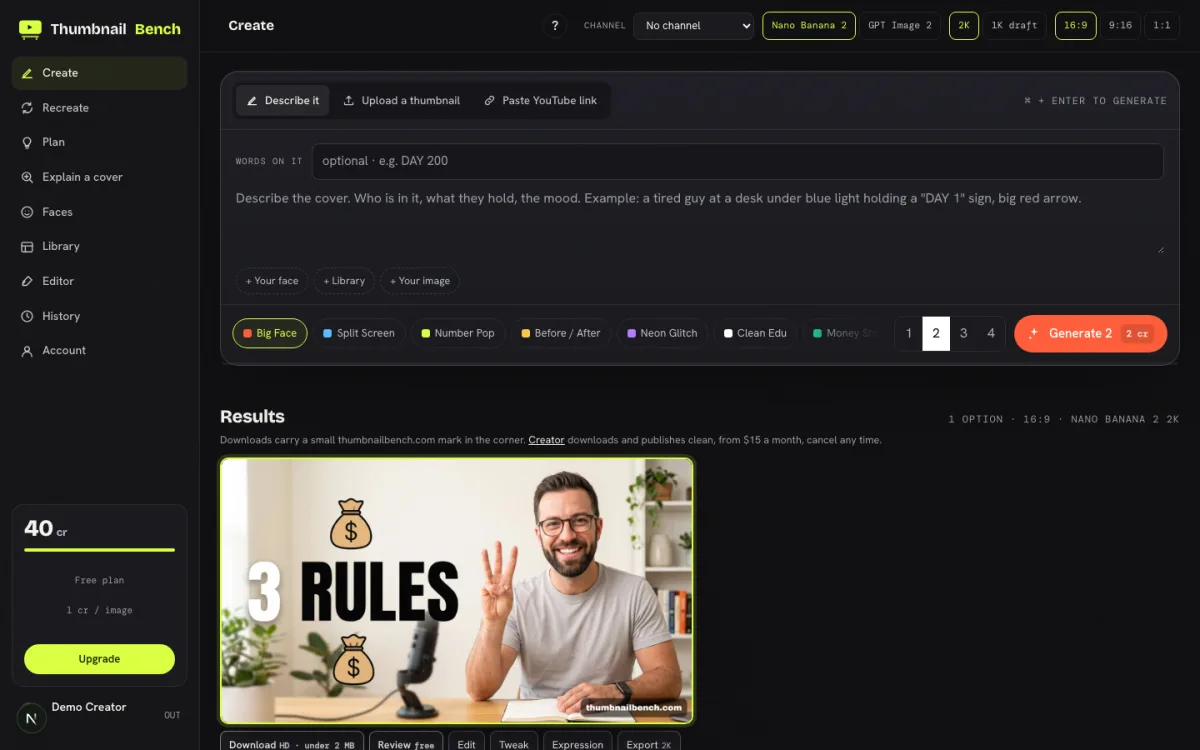
  1. Create screen with a prompt box, a words-on-it field, style chips, a Generate 2 button, and a finished render reading 3 RULES
    STEP 1 OF 6

    Create

    Describe the cover, add the words for it, pick a style and choose up to four options. Each image costs one credit. Free downloads carry a small corner mark.

    WHERE AI IS INVOLVEDNano Banana 2 on Kie renders the picture at 2K. GPT Image 2 is an opt-in second model.
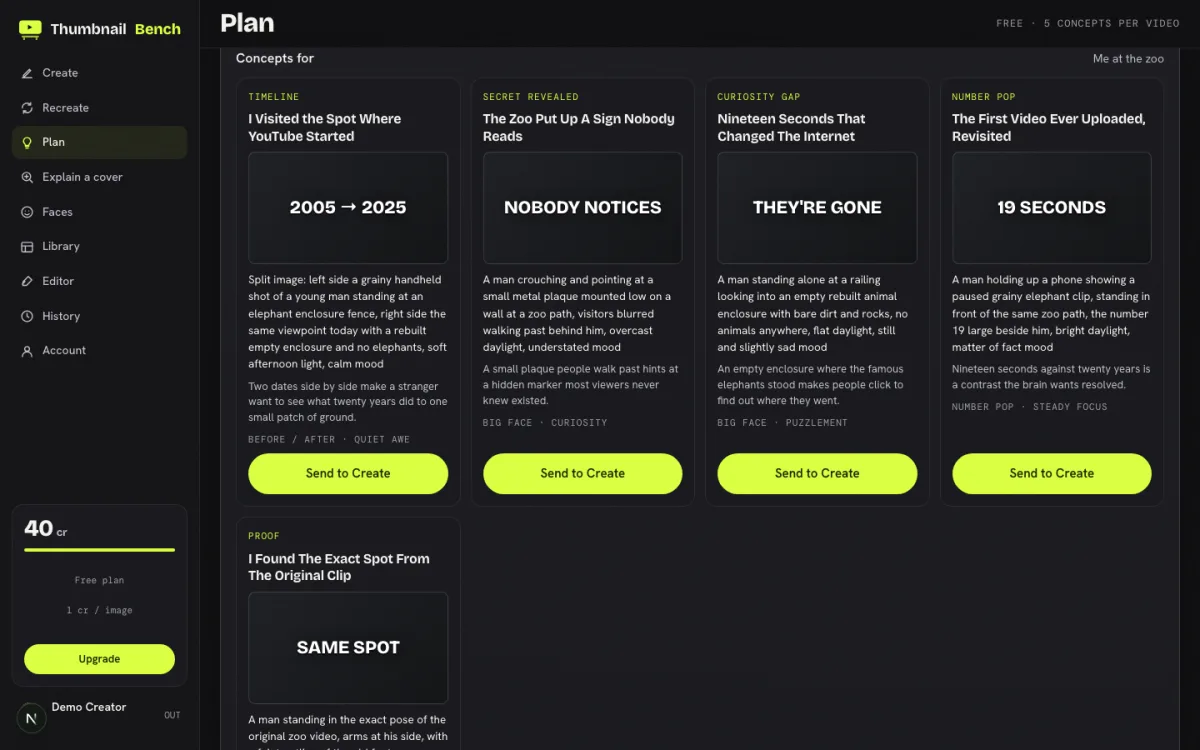
  2. Plan screen showing five thumbnail concepts for a YouTube video, each with a title, a headline, a scene and a Send to Create button
    STEP 2 OF 6

    Plan

    Paste a YouTube link, a script or an idea. The bench returns five different angles, each with a title, the words for the cover and a scene. Send to Create fills in the brief. Plan uses no credits.

    WHERE AI IS INVOLVEDClaude Opus 5 writes the five concepts. These are its real answer for a public YouTube video.
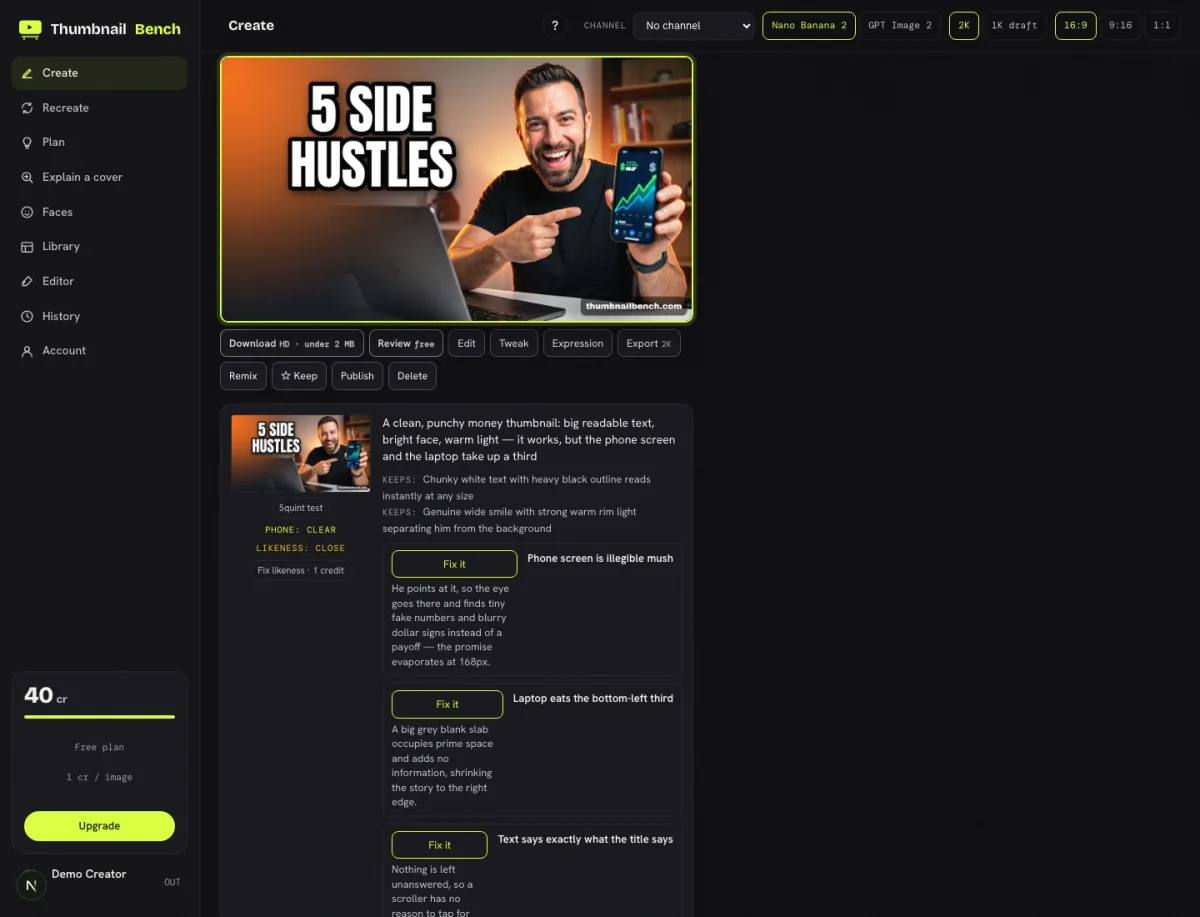
  3. A render reading 5 SIDE HUSTLES with a review panel below it: a verdict, two things to keep, faults with Fix it buttons, and phone and likeness checks
    STEP 3 OF 6

    Review

    Review gives a verdict, what to keep and up to four faults. Each fault has a Fix it button that sends the change to Tweak.

    WHERE AI IS INVOLVEDClaude reads the render against a rubric. It checks the cover at phone size and compares the face with the creator's photo.
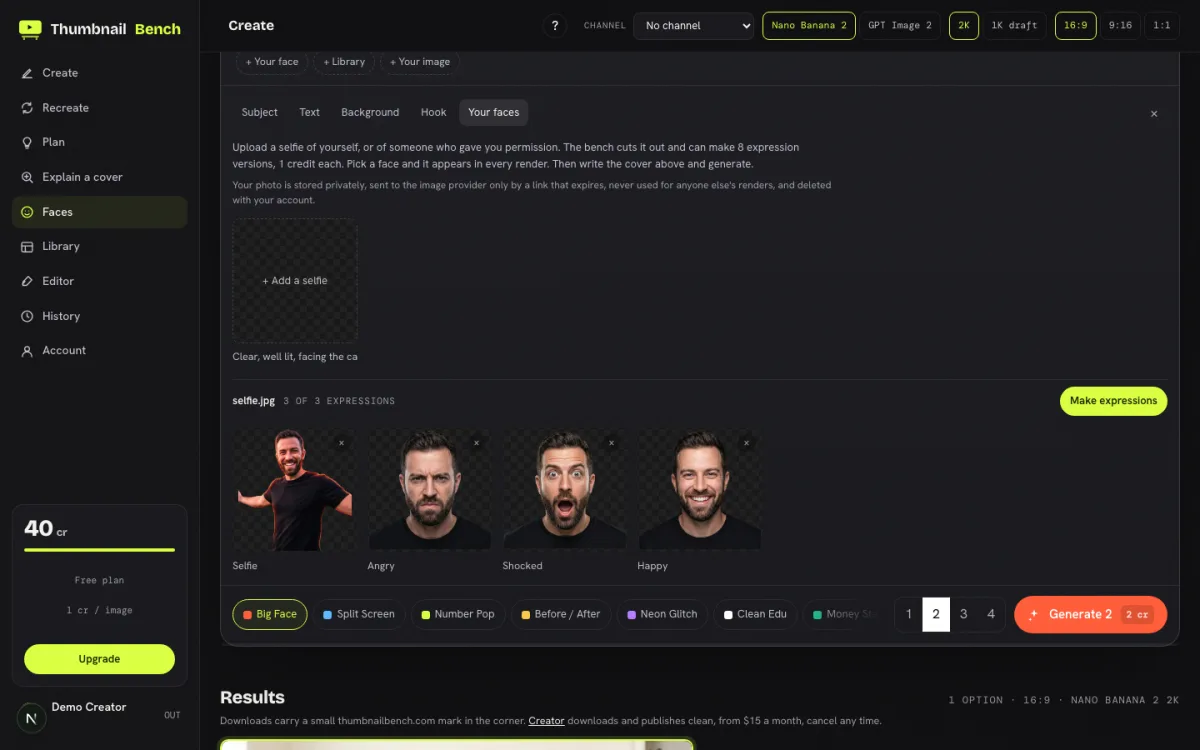
  4. Your faces panel with a selfie cut-out and three expression versions labelled Angry, Shocked and Happy
    STEP 4 OF 6

    Faces

    Upload a selfie once. The bench cuts it out and can make expression versions, one credit each. A chosen face goes into every render. The face here is an AI-generated stand-in, not a real person.

    WHERE AI IS INVOLVEDBiRefNet on fal.ai cuts the face out. Nano Banana 2 makes each expression from the selfie.
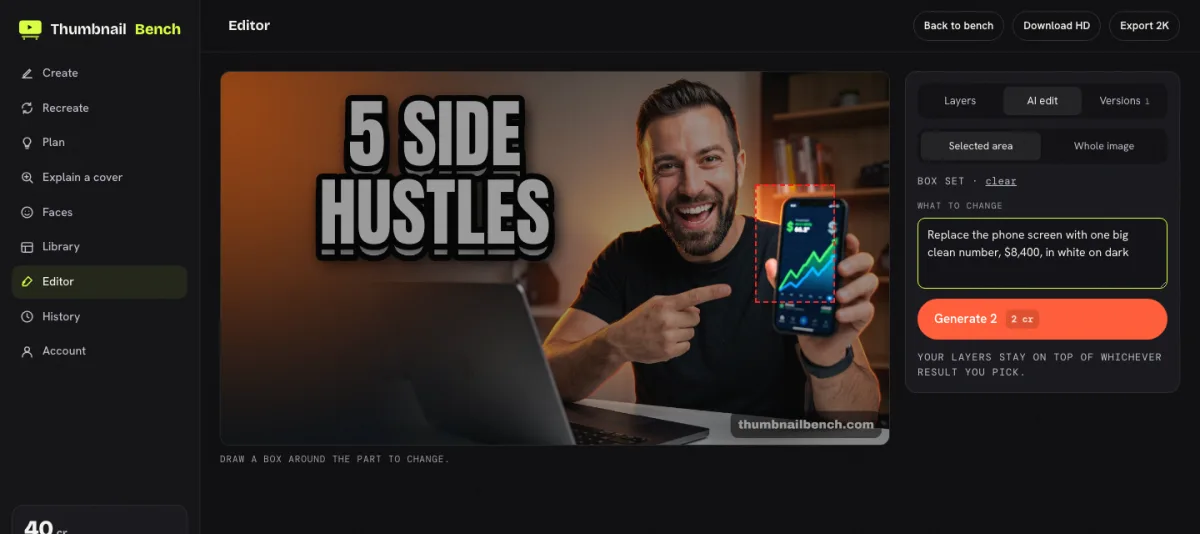
  5. Editor with a dashed box drawn around the phone in a render and an AI edit panel asking what to change inside the box
    STEP 5 OF 6

    Editor

    Draw a box and say what to change. Only the inside of the box changes. Text layers are drawn by code, so every word is spelled right.

    WHERE AI IS INVOLVEDAn image model redraws the picture with the box marked. Code then pastes back only the inside of the box, with a soft edge.
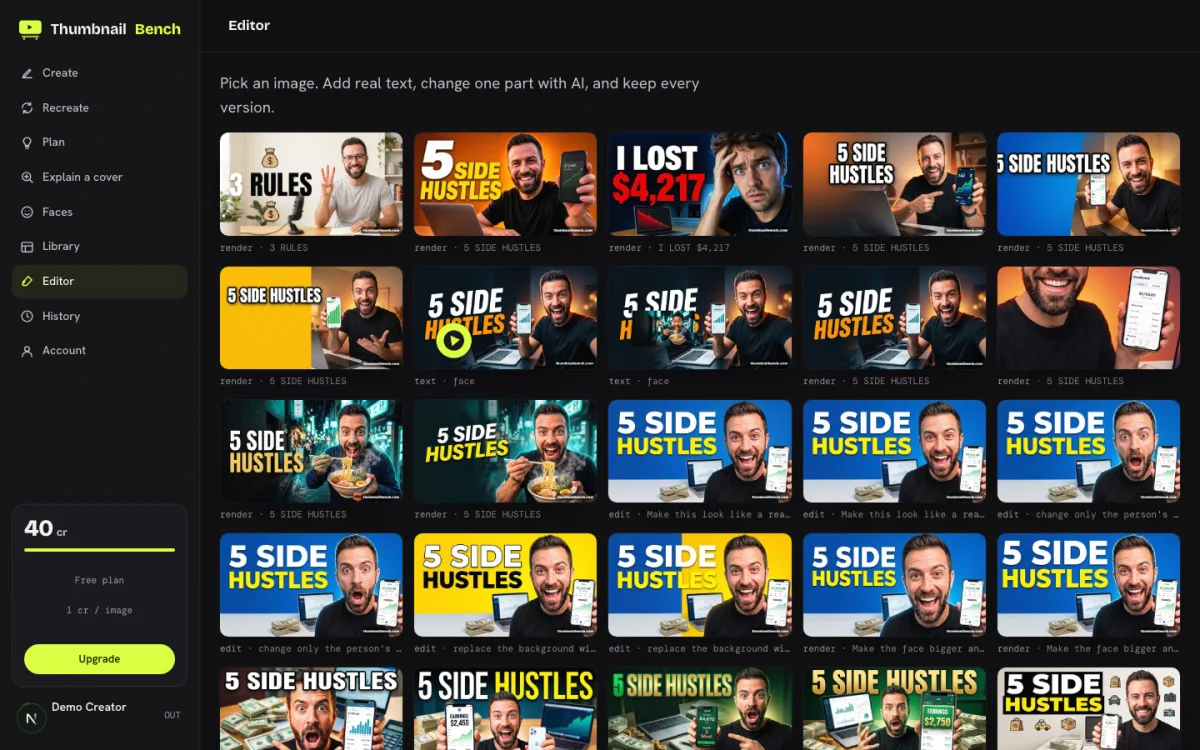
  6. Editor picker with a grid of past thumbnails, each labelled render, edit or text
    STEP 6 OF 6

    Every version kept

    Every render, AI edit and text version is saved and labelled. A creator can go back to any of them and keep working.

Let's talk about
what you need built.

Open to AI roles: full-time, contract or consulting. I build AI products, internal tools and automations with AI coding agents.